

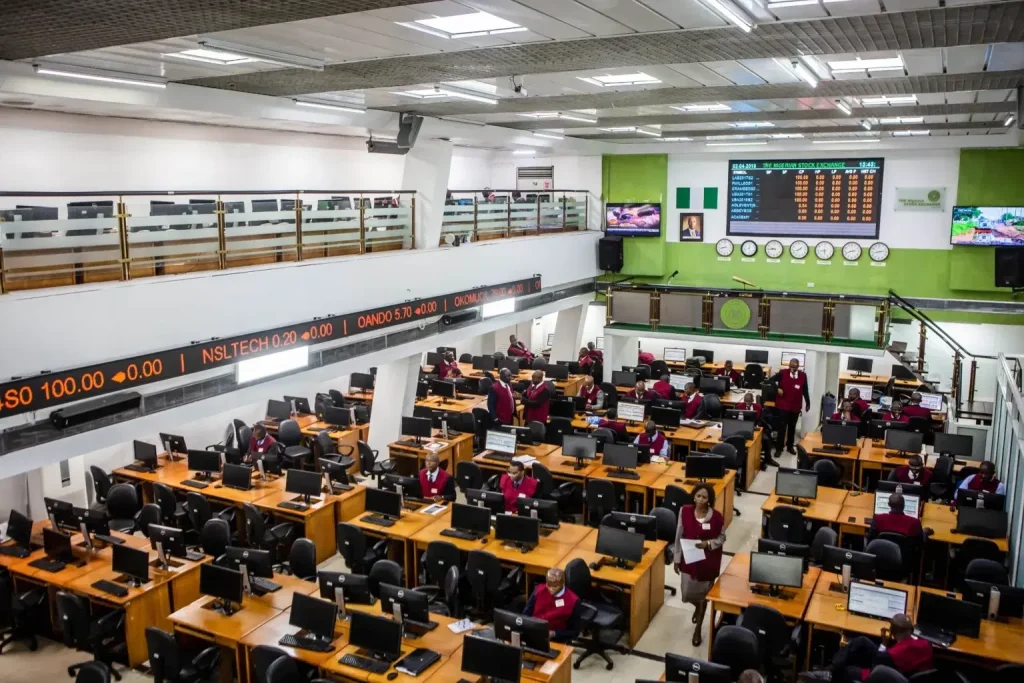
Nigeria’s equities market has recorded a sharp rise in value in 2026, but the gains remain heavily concentrated among a relatively small group of companies. As of August 17, 24 companies accounted for 74.8 per cent of the total market capitalisation of the Nigerian Exchange Limited (NGX). The companies, drawn mainly from the banking, consumer goods, industrial goods and energy sectors, had a combined market value of N117.01 trillion.
The concentration comes as the overall NGX market capitalisation climbed by N57.141 trillion, or 57.5 per cent, from N99.376 trillion at the end of 2025 to N156.517 trillion. Analysts said the strong performance reflects significant gains in several large-cap stocks. However, they warned that heavy concentration means movements in a handful of companies could have an outsized effect on the wider market.
Dangote Cement emerged as the most capitalised company, overtaking MTN Nigeria.
The leading companies include Dangote Cement, MTN Nigeria, BUA Foods, BUA Cement, Aradel Holdings, First Holdco, HBM Nigeria, Zenith Bank, GTCO, Stanbic IBTC Holdings, Transcorp Hotels, Presco, Nestlé Nigeria, Nigerian Breweries, Geregu Power, UBA, International Breweries, Transcorp Power, Access Holdings, Fidelity Bank, Okomu Oil Palm, Ecobank Transnational Incorporated and Wema Bank.
Banks remained prominent among the most valuable stocks. First Holdco led the banking group with N6.37 trillion, followed by Zenith Bank at N5.04 trillion and GTCO at N4.70 trillion. Stanbic IBTC recorded N2.56 trillion, while UBA stood at N1.99 trillion. Access Holdings and Fidelity Bank were valued at N1.45 trillion and N1.38 trillion respectively.
BUA Foods dominated the consumer goods segment with a market capitalisation of N13.69 trillion. Presco followed with N2.40 trillion, while Nestlé Nigeria, Nigerian Breweries and International Breweries recorded N2.22 trillion, N2.10 trillion and N1.79 trillion respectively.
In industrial goods, Dangote Cement led with N17.15 trillion, ahead of BUA Cement at N13.69 trillion and HBM Nigeria at N5.38 trillion. The energy segment also featured prominently, with Seplat Energy and Aradel Holdings reported at about N6.72 trillion each, while Geregu Power and Transcorp Power stood at N2.06 trillion and N1.65 trillion.
Despite the broad Nigerian stock market rally, individual stocks have produced widely different results. Zichis Agro Allied Industries was the strongest gainer, rising 1,744.22 per cent year-to-date to N18.35 per share. SCOA Nigeria gained 365.49 per cent, while Infinity Trust Mortgage Bank appreciated 221.43 per cent. Berger Paints, Premier Paints, First Holdco, Vitafoam Nigeria and HBM Nigeria also recorded substantial gains.
However, Sovereign Trust Insurance was the worst performer, falling 50.39 per cent to N1.89. Ellah Lakes, Guinea Insurance, SUNU Assurances, Austin Laz and several other stocks also recorded significant declines. Analysts therefore cautioned investors against assuming that the market-wide rally represents an across-the-board improvement.
David Adonri, Chief Executive Officer of Highcap Securities Limited, said the concentration of market value among large companies means investors should look beyond the All-Share Index when making investment decisions. He advised investors to assess individual companies based on earnings, valuations and underlying fundamentals rather than simply chasing stocks with strong year-to-date returns.
The ranking changes when companies are assessed by total assets rather than market value. Ecobank Transnational Incorporated had the largest asset base in the second quarter of 2026 at N49.15 trillion, followed by First Holdco with N30.65 trillion. Aradel Holdings ranked third with N10.88 trillion, while FCMB and Oando recorded N8.36 trillion and N7.89 trillion respectively.
Analysts, however, warned that a large asset base does not automatically translate into profitability or strong shareholder returns. They also raised concerns about companies with negative shareholders’ equity, including Aradel Holdings and Oando.
According to analysts, investors should examine debt levels, cash flow, capital structure, earnings growth, dividend prospects and return on equity before committing funds. The divergent performances suggest that while the market has delivered impressive headline gains in 2026, investors still need to distinguish between market momentum and genuine improvement in corporate fundamentals.