
The restoration of six previously suppressed state constituencies in Delta State by the Independent National Electoral Commission (INEC) has reignited concerns in Ughelli South Local Government Area, where residents say a court-backed constituency remains excluded more than a decade after judicial rulings ordered its return.
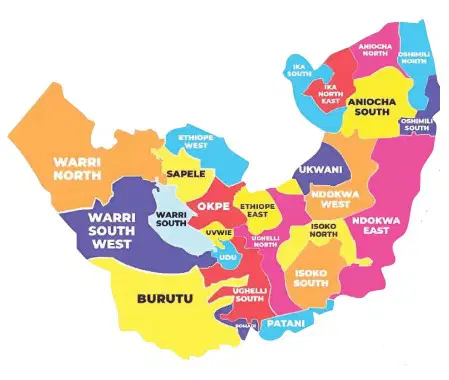
On June 10, INEC announced the restoration of 22 state constituencies across Delta, Benue, Jigawa and Kogi states. Delta regained six seats: Aniocha North II, Ika North East II, Sapele II, Ethiope West II, Warri South West II and Warri North II. However, the Ughelli South constituency was not included despite multiple court judgments directing its restoration.
Before 1999, Ughelli South Local Government Area had two representatives in the Delta State House of Assembly, known as Ughelli South I and Ughelli South II.
Historical records show the arrangement existed during Nigeria’s First, Second and Third Republics. During the First Republic, Chief Patrick K. Tabiowo represented Ughelli South I and became the first Speaker of the Midwestern House of Assembly, while another legislator represented the Ewu, Okparabe, Arhavwarien, Effurun-Otor and Olomu axis.
The dual representation continued under the Second Republic between 1979 and 1983, with Sir Harrison Jefia representing Ughelli South I and Chief Sylvanus Omaruaye representing Ughelli South II. Following the creation of Delta State, the First Delta State House of Assembly inaugurated in January 1992 also maintained the two constituencies, represented by Hon. Wilson Jighwu and Hon. George Dogood Mokpo respectively.
The structure changed at the beginning of the Fourth Republic in 1999 when INEC merged the two constituencies into one during its constituency delimitation exercise. The decision reduced Ughelli South’s representation in the Delta State House of Assembly from two seats to one despite its growing population and numerous communities. Residents challenged the decision in 2014.
Chief Godwin Sito and five other plaintiffs approached the Federal High Court in Warri in Suit No. FHC/WR/CS/59/2014, asking the court to compel INEC to restore the constituency.
Justice Mohammed Shitu Abubakar ruled on October 31, 2014, that INEC had no constitutional authority to suppress the lawfully created constituency. The court ordered the commission to immediately restore Ughelli South I, conduct a by-election and stop denying residents their constitutional right to representation.
INEC appealed the judgment, but the Court of Appeal sitting in Benin dismissed the appeal on May 28, 2015.
Justice H. Barka, who delivered the lead judgment, affirmed that the constituency had existed separately before 1996 and upheld the lower court’s decision. Following continued non-compliance, the plaintiffs initiated contempt proceedings against the then INEC Chairman, Professor Attahiru Jega, by serving Form 48 and Form 49 notices. The legal battle eventually reached the Supreme Court.
In 2017, the apex court, in the case of INEC v. Chief Godwin Enasito, affirmed both the Federal High Court and Court of Appeal judgments, maintaining that the suppression of the constituency was unlawful. Despite victories at three different courts, the Ughelli South constituency has yet to be restored.
INEC said the latest restoration exercise followed court judgments directing the commission to reinstate previously suppressed constituencies. National Commissioner Mohammed Kudu Haruna stated that the restoration was carried out under powers granted by the 1999 Constitution and the Electoral Act 2026.
Residents of Ughelli South, however, argue that the same constitutional provisions required compliance with the earlier judgments obtained over a decade ago. Some legal observers have questioned why constituencies affected by more recent judgments were restored while the Ughelli South ruling remains unenforced.
Some observers believe restoring Ughelli South II would increase the number of members in the Delta State House of Assembly from 29 to 31, unlike the recent restorations, which maintained the existing membership through seat replacements.
An unnamed INEC official reportedly suggested that implementing older judgments would require fresh ward delineation, updated polling units and boundary verification. However, social justice advocate Zik Gbemre rejected that explanation, arguing that administrative difficulties cannot justify failure to comply with valid court judgments.
Community members say the prolonged absence of the second constituency has affected representation and access to constituency projects across several communities within the local government. The current arrangement leaves a single lawmaker representing an area with an estimated population exceeding 300,000 people.
Stakeholders insist that the issue is no longer about obtaining legal victories but ensuring implementation. While six Delta constituencies have now returned to the electoral map, the Ughelli South constituency remains absent despite judgments from the Federal High Court, the Court of Appeal and the Supreme Court directing its restoration.