

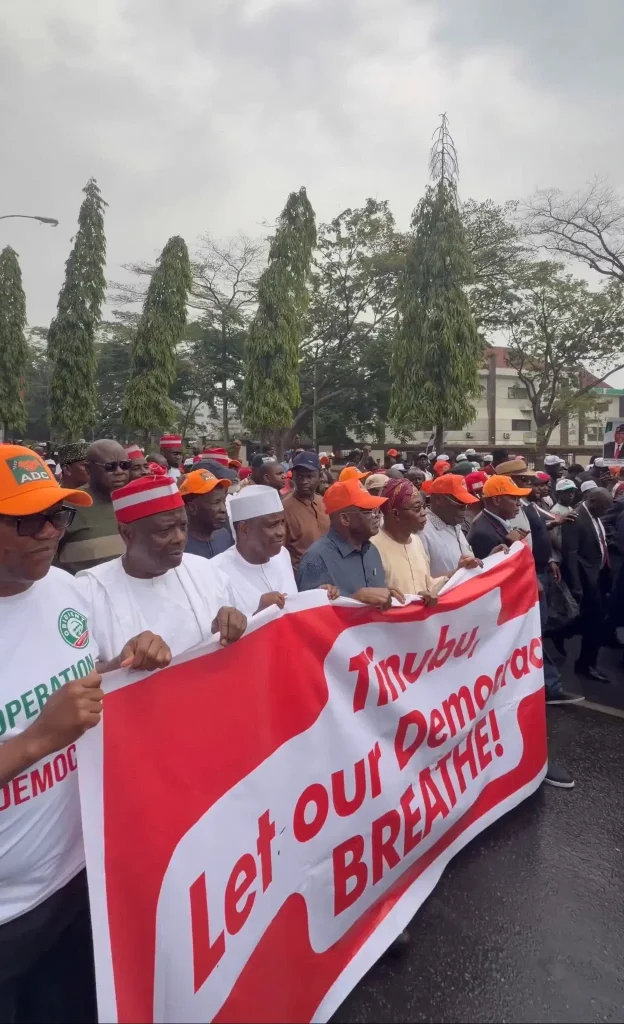
An INEC protest in Abuja drew major political figures including Atiku Abubakar, Peter Obi, Rabiu Kwankwaso, and Rauf Aregbesola, as a coalition of opposition actors gathered at the headquarters of the Independent National Electoral Commission.
The demonstration reflects growing concerns around electoral processes and institutional decisions ahead of future elections.
The INEC protest formed part of a broader mobilisation involving members of the African Democratic Congress and other political stakeholders.
Participants converged in large numbers, turning the event into a multi-party demonstration focused on electoral transparency and governance accountability.
The procession began at the residence of former Senate President David Mark in Apo Legislative Quarters, where a gathering had earlier taken place.
From there, participants moved toward the electoral commission’s headquarters, with supporters joining along the route.
A participant, Muyideen Bashiru, described the turnout, stating, “You can see the crowd; there are hundreds, possibly thousands of people gathered.” The scale of participation highlighted the level of engagement across different political groups.
Earlier plans for the INEC protest had been postponed due to heavy security presence in parts of the Federal Capital Territory.
The rescheduled event, however, recorded a larger turnout, with observers noting increased coordination among participants.
Atiku Abubakar, in a statement, said the demonstration was aimed at defending democratic structures.
He noted that the action was necessary to “safeguard our democracy and prevent the enthronement of a dictatorship.”
Despite rainfall during the march, participants continued the movement toward the INEC headquarters.
Observers described the gathering as organised, with demonstrators maintaining focus on their demands throughout the exercise.
The INEC protest also comes amid internal developments within the African Democratic Congress and wider political realignments.
Decisions by the electoral commission regarding party leadership recognition have contributed to heightened tensions within the political environment.
Analysts note that the presence of key opposition figures at the protest signals increasing cooperation among political actors ahead of the 2027 general elections.
The development reflects efforts to engage institutions and shape the direction of electoral processes.
The demonstration further underscores the role of civic mobilisation in Nigeria’s democratic system. Public gatherings such as this are often used to express concerns and demand accountability from institutions responsible for governance.
The INEC protest highlights growing attention on electoral transparency and the role of institutions in maintaining public confidence. Multi-party participation indicates shared concerns across political lines.
Such developments may influence political strategies and institutional engagement as preparations for future elections continue.