



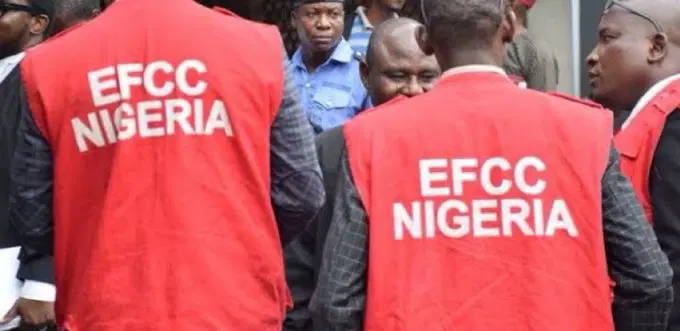
The Economic and Financial Crimes Commission (EFCC) has alleged that a new-generation bank, multiple fintech companies and microfinance banks enabled the flow of N162 billion in cryptocurrency transactions and N18.7 billion in scam-linked proceeds through Nigeria’s financial system without performing required checks, the Commission said on Thursday, January 22, 2026.
The disclosure came during a media briefing in Abuja by EFCC’s Director of Public Affairs, Mr Wilson Uwujaren as the Commission reported major investigative breakthroughs in the 2026 operational year.
Uwujaren said that investigations found financial institutions compromised mandatory Know Your Customer (KYC) and Customer Due Diligence (CDD) requirements, allowing fraudsters, including foreign nationals, to convert illicit funds into digital assets and move them to offshore destinations.
He described the findings as “worrisome”, stressing that failure to monitor suspicious transactions has weakened safeguards designed to protect the nation’s financial integrity.
The EFCC’s briefing detailed how the compromised platforms allowed large volumes of cryptocurrency transactions totaling N162 billion to pass through regulated channels without proper verification.
In one striking case, investigators found that a single customer maintained 960 bank accounts within one new-generation bank, all allegedly used for fraudulent purposes.
According to Uwujaren, the EFCC also uncovered two major fraud schemes that exploited these gaps. The first involved an airline ticket discount fraud, where victims were misled into believing they were paying a legitimate carrier, only to have their accounts emptied.
More than 700 victims lost a combined N651.1 million, of which N33.62 million has been recovered and returned to some victims.
The second scheme centred on bogus investment platforms, linked to companies such as Fred and Farid Investment Limited (FF Investment) and eight others.
This second category of fraud defrauded more than 200,000 Nigerians, generating about N18.08 billion that was routed through the compromised financial institutions.
Uwujaren stressed that foreign nationals were principally identified as the masterminds behind the fraud networks, with three Nigerian accomplices already arrested and charged to court, while others remain at large.
He warned that institutions found to be aiding such fraud could face suspension, investigation and prosecution, calling on regulators to enforce strict compliance with anti-money laundering requirements.
The EFCC urged regulatory authorities to compel financial institutions to strengthen internal controls, monitor structured and suspicious transactions, and fully observe KYC, CDD and Suspicious Transaction Report (STR) obligations.
“Negligence and failure to monitor suspicious or structured transactions will no longer be tolerated,” Uwujaren said, emphasising the need to safeguard public trust and economic stability.
The Commission’s revelations point to systemic weaknesses in financial sector compliance oversight that fraud networks have exploited. Analysts say such lapses not only facilitate large-scale laundering of illicit proceeds but also erode confidence in regulatory frameworks designed to protect the banking and digital asset ecosystem.
The EFCC reaffirmed its commitment to combating money laundering and financial crimes and said it would continue to pursue investigations to their logical conclusion, warning that financial institutions must upgrade operational dynamics to prevent further abuse of Nigeria’s financial infrastructure.
As the EFCC intensifies efforts to clamp down on fraud and money laundering, regulators and financial institutions face increased scrutiny to improve compliance, enforcement and risk management practices to safeguard the integrity of Nigeria’s financial system.