

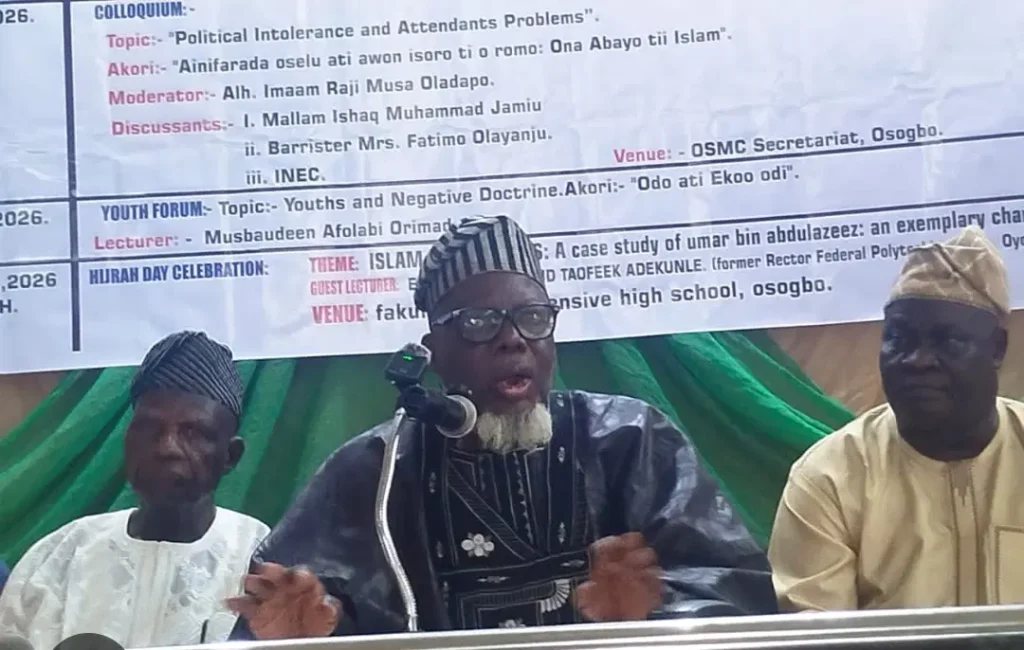
An Islamic cleric, Dr. Abdulateef Abdulhakeem, has criticised the practice of granting pardons and reintegrating convicted criminals into society, arguing that it is inconsistent with Islamic principles. He also renewed calls for wider establishment of Shariah courts Nigeria, saying they are essential for promoting justice and regulating the conduct of Muslims. Abdulhakeem made the remarks on Saturday while delivering a lecture during the 20th anniversary of the Osun State Independent Shari’ah Panel in Osogbo.
The cleric said the implementation of Shariah is designed to ensure justice and accountability, maintaining that Islam does not support the release of convicted offenders through executive discretion or political influence. According to him, some state governments have been reluctant to establish Shariah courts because doing so would reduce certain discretionary powers exercised by political office holders.
“Shari’ah is meant to establish justice. Islam does not support what I describe as a ‘prerogative of injustice,’ whereby a killer is released because of closeness to those in authority. “Nigerians do not want Shari’ah because it does not support mercy for criminals or their reintegration into society,” he said.
Speaking on Shariah courts Nigeria, Abdulhakeem urged governments at all levels to implement Section 275 of the Constitution, which provides for the establishment of Shariah courts where required. He said Muslims were only asking that constitutional provisions already in place be implemented.
“In Islam, we are not asking for anything beyond what the Constitution already provides. Section 275 makes provision for Shari’ah courts, and any state that desires one should establish it.
“Even if there is only one Muslim in a state, that person’s rights, including freedom of religion, association and personal liberty, must be protected through the establishment of the appropriate institution,” he said.
Abdulhakeem explained that the primary responsibility of Shariah courts Nigeria is to regulate the conduct of Muslims and ensure compliance with Islamic teachings. According to him, the courts can help address criminal behaviour among adherents of Islam while reinforcing the religion’s prohibition of violence and terrorism.
“If there is a Shari’ah court, it will regulate the excesses of Muslims. Government can empower it to address criminal tendencies among those who profess the Islamic faith because no religion permits the unlawful killing of others.
“In the name of Islam, you cannot kill or engage in terrorism because such acts are prohibited by the Qur’an,” he said.
He added that the Shariah court is intended to serve Muslims within its constitutional jurisdiction and is not compulsory for Christians, who remain subject to the conventional court system.
Earlier at the event, the President of the Osun State Muslim Community, Alhaji Mustafa Olawuyi, commended individuals who have contributed to the growth and activities of the Osun State Independent Shari’ah Panel since its establishment, describing their efforts as important to the advancement of the organisation’s objectives.