
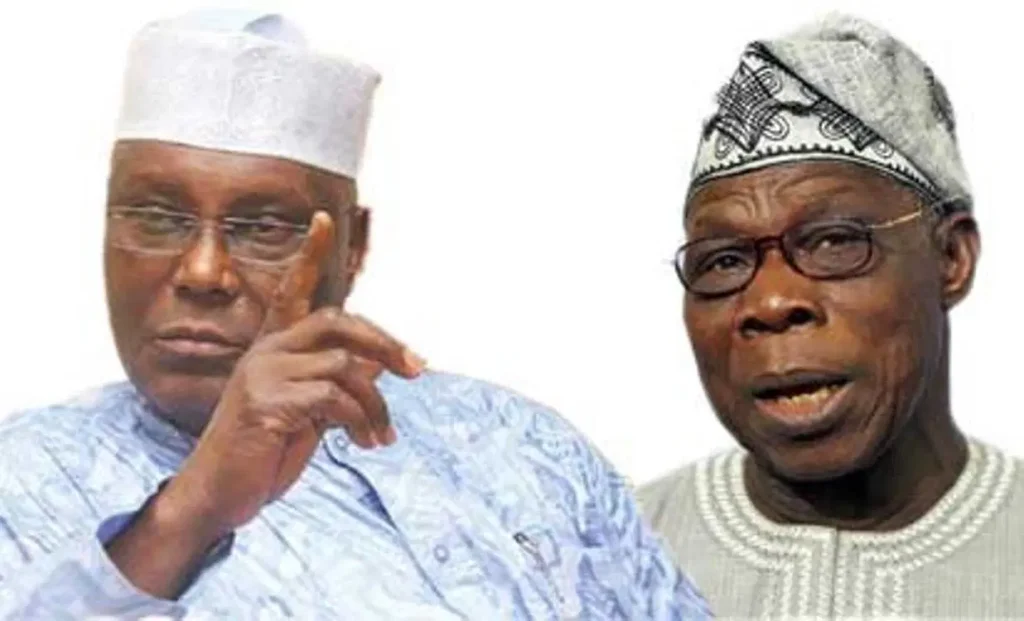
The presidential candidate of the African Democratic Congress (ADC), Atiku Abubakar, has accused former President Olusegun Obasanjo of allowing resentment over the collapse of his alleged third-term ambition to shape his recent criticisms against him.
Responding through a statement issued by his Senior Special Assistant on Public Communication, Phrank Shaibu, Atiku said he received Obasanjo’s latest remarks with disappointment rather than anger, describing them as another attempt to distort historical events. The Atiku Obasanjo feud resurfaced after Obasanjo recently described appointing Atiku as his vice president as his greatest political regret.
In his response, the former vice president revisited their long-standing relationship, claiming he remained loyal to Obasanjo during his imprisonment by supporting his family and campaigning for his release. According to Atiku, he also assisted the former president after his release by helping him regain stability and supporting the political alliances that eventually led to his emergence as Nigeria’s president.
“History records that while Chief Obasanjo was in prison, I stood firmly by him. I supported his family, worked tirelessly with other patriots for his release and never wavered in my belief that he deserved his freedom,” Atiku said.
He further claimed that Obasanjo had little after regaining his freedom, adding that he provided clothing, care and other forms of support during that period.
Addressing the long-running dispute over Obasanjo’s alleged third-term agenda, Atiku maintained that he remained proud of opposing any move that would have extended the former president’s tenure beyond constitutional limits. He said his decision was motivated by a commitment to Nigeria’s Constitution rather than personal rivalry.
“I am proud that I stood against the third-term agenda. I am proud that I stood by the Constitution of the Federal Republic of Nigeria,” he stated.
According to Atiku, if Obasanjo’s criticism stems from his refusal to support a constitutional amendment for a third term, he considers that opposition a matter of principle and “a badge of honour.” He argued that defending constitutional democracy was more important than personal political relationships.
Atiku also referenced recent comments by the Director-General of the World Trade Organization (WTO), Dr. Ngozi Okonjo-Iweala, who reportedly praised the economic management team that served during the Obasanjo administration.
He questioned why the former president chose this moment to criticise his contributions despite such recognition from senior public officials. The former vice president said he had no regrets about helping Obasanjo during difficult moments, insisting that acts of kindness should not be viewed as transactions expecting repayment.
“Acts of kindness are matters of conscience, not commercial transactions,” he said.
Atiku expressed concern that political energy was being spent revisiting old disagreements while Nigerians continued to grapple with economic hardship, unemployment and insecurity. He argued that national attention should be directed toward rebuilding the country ahead of the 2027 general election rather than reopening historical political disputes.
The ADC candidate said he had remained silent for years out of respect for the office Obasanjo once occupied but added that continued attempts to distort historical events could no longer go unanswered. While acknowledging Obasanjo’s right to express personal opinions, Atiku insisted that historical facts could not be altered by personal grievances. He concluded that history and, ultimately, Nigerians would judge the contributions of both men.