

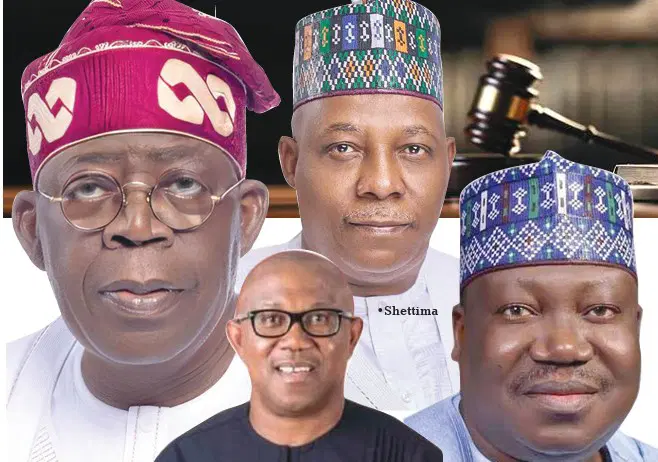
The NDC deregistration ruling has triggered renewed national debate over judicial accountability, political competition and the future of Nigeria’s multi-party democracy as preparations intensify for the 2027 general elections.
The controversy followed a decision by the Federal High Court in Lokoja, which reversed its earlier judgment directing the Independent National Electoral Commission (INEC) to register the Nigeria Democratic Congress (NDC). The party is the platform of its presidential candidate, Peter Obi, with former Kano State Governor Rabiu Musa Kwankwaso serving as his running mate.
Justice Isah Dashen ruled that the earlier judgment delivered on December 10, 2025, affected the rights of the Peace Movement Party (PMP), which was not joined in the original proceedings despite claiming ownership of the logo used in the registration process. Counsel to the applicant, C. S. Ekeocha, said the court agreed that PMP’s interests were affected and therefore vacated the previous judgment.
According to him, the ruling restores all parties to the position they occupied before the December 2025 judgment, while directing that all necessary parties be joined before the matter is heard afresh. Ekeocha said the implication was that every action taken by INEC under the earlier judgment, including the recognition of the NDC and issuance of its registration certificate, stands reversed pending the final determination of the substantive case.
The NDC deregistration ruling was immediately challenged by the party. National Leader Henry Seriake Dickson announced that the NDC had filed an appeal alongside an application for a stay of execution.
He disclosed that INEC had granted the party access to its nomination portal and confirmed that the names of himself and Peter Obi had already been uploaded, while the vice-presidential nomination would follow after completion of the required documentation. Dickson maintained that the party remains fully compliant with INEC’s timetable for submitting candidates for the 2027 elections.
The court’s decision has intensified concerns among opposition figures who argue that legal processes could be used to narrow political competition before the 2027 presidential election. Former Vice President Atiku Abubakar described the judgment as reinforcing fears that viable opposition platforms could face institutional obstacles, warning that limiting political choices may weaken democratic governance.
Senior Advocate of Nigeria, Femi Falana, also criticised the ruling, arguing that once a court delivers a final judgment, it becomes functus officio and cannot reverse its own decision except under limited legal circumstances. Falana maintained that actions already taken under the earlier judgment, including the NDC primary elections, remain legally valid.
The NDC deregistration ruling has also revived broader discussions about judicial accountability in Nigeria. Several legal analysts pointed to previous election-related controversies involving former Senate President Ahmed Lawan, the Plateau State legislative disputes and litigation arising from the 2023 presidential election involving President Bola Tinubu, Atiku Abubakar and Peter Obi.
Civil society organisation ActionAid Nigeria similarly questioned whether increasing reliance on courts to resolve political disputes reflects growing public distrust in electoral institutions. In a presentation delivered during a conference organised by the Nigerian Guild of Editors, the organisation noted that election litigation has risen sharply, increasing from two cases in 1999 to 1,926 cases following the 2023 elections.
ActionAid argued that judicial independence, transparency, adequate funding and stronger oversight remain essential to preserving democratic credibility. The organisation also urged the media to continue promoting public awareness and accountability on judicial reforms.
The latest legal developments leave the NDC registration dispute awaiting a fresh hearing before the Federal High Court, while the party’s appeal proceeds through the judicial process. The outcome is expected to remain significant as political parties conclude candidate nominations and Nigeria moves closer to the 2027 general elections.