

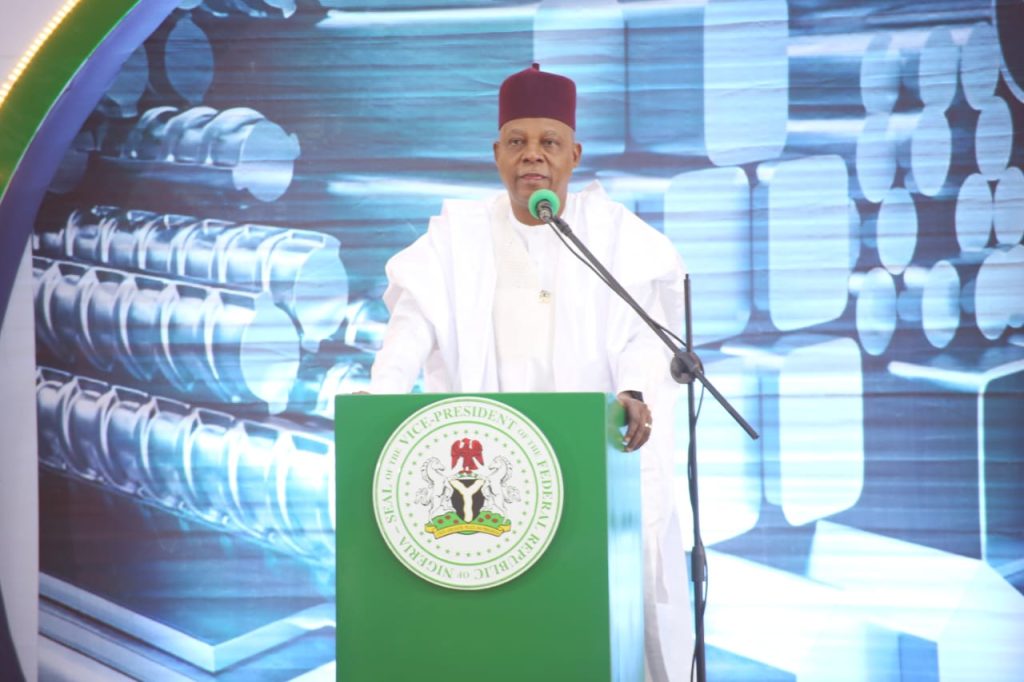
The government business engagement agenda remains central to Nigeria’s economic reforms, with Vice President Kashim Shettima stating that no government can fully understand or grow the economy without maintaining close collaboration with employers and the private sector.
Speaking at the 5th Nigerian Employers’ Summit in Abuja, the Vice President, represented by former Minister of the Federal Capital Territory and Special Adviser to the President on General Duties, Dr. Aliyu Modibbo Umar, said sustained dialogue between government and businesses is critical to achieving inclusive and lasting economic growth.
Shettima described the summit as timely, noting that Nigeria is at a crucial stage of its economic transformation. According to him, meaningful reforms require honest discussions on issues affecting businesses, including production costs, access to finance, exchange rates, taxation and investment.
“It is honest because reform demands difficult conversations about production costs, access to credit, exchange rates, taxation and investment. “It is necessary because the private sector cannot compete on sentiment. It competes on functional infrastructure, predictable policies, fair taxation and reliable energy,” he said.
He commended the Nigeria Employers’ Consultative Association (NECA) for nearly seven decades of promoting collaboration between government, labour, development partners and the business community.
The Vice President said President Bola Tinubu inherited an economy facing deep structural challenges, including an unsustainable fuel subsidy regime, a fragmented foreign exchange market, weak government revenue and declining investor confidence.
According to Shettima, the administration chose to implement difficult but necessary reforms rather than postpone them. He said: “the easy option at that time was to postpone difficult decisions. But leadership is tested when the right decision is also the difficult one.”
He explained that the Renewed Hope Agenda was designed to address these structural weaknesses and build a stronger foundation for sustainable economic growth.
The Vice President said government business engagement includes reducing bureaucratic bottlenecks and digitising government services to improve the ease of doing business nationwide.
He stressed that reforms announced in Abuja must translate into practical improvements for businesses operating in Lagos, Kano, Aba and other parts of the country. Shettima also defended the removal of fuel subsidy and the liberalisation of the foreign exchange market, describing both reforms as necessary to restore macroeconomic stability.
He added that ongoing fiscal and tax reforms are intended to reduce multiple taxation, simplify tax administration, support small businesses and encourage wider tax compliance. According to him, businesses are more concerned about excessive taxes, regulatory uncertainty and administrative delays than taxation itself.
In his welcome address, NECA Director-General Adewale Oyerinde said the Employers’ Summit has, over the past five years, generated practical policy recommendations that have informed government decision-making.
He noted that since its inaugural edition at the Transcorp Hilton Abuja, the summit has continued to strengthen collaboration between government and the organised private sector while contributing to national discussions on enterprise sustainability, job creation and inclusive economic development.