

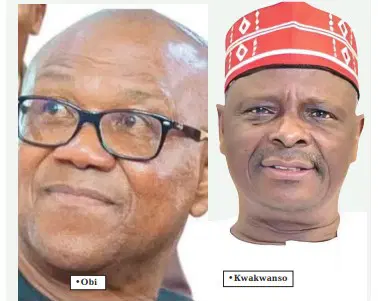
The proposed Obi-Kwankwaso Alliance ahead of the 2027 presidential election is facing resistance from some northern political stakeholders and sections of the electorate, according to findings by Sunday PUNCH. While critics argue that the Nigeria Democratic Congress (NDC) lacks visibility and acceptance in parts of the region, party leaders insist support for the platform is growing across northern states.
Recent political developments have intensified discussions about the electoral prospects of former Anambra State Governor Peter Obi and former Kano State Governor Rabiu Kwankwaso under the NDC platform.
Reports indicate that some northern leaders have cautioned supporters against backing the party, while campaign materials circulating on social media platforms have portrayed the political partnership negatively. In Kano State, campaign posters featuring Obi and Kwankwaso were reportedly destroyed by youths in Ungogo Local Government Area. The political environment was further highlighted by the return of Kano lawmaker Muhammad Tomas to the All Progressives Congress after briefly joining the NDC.
The National Publicity Secretary of the Arewa Consultative Forum, Prof. Tukur Muhammad-Baba, said the NDC remains largely unknown to many northern voters. According to him, visibility remains a major challenge for the party across much of the region.
“There is even doubt about whether Kwankwaso can still hold on to Kano, where he recorded his most impressive performance in the last election. Apart from Kano, his influence in many parts of the North remains uncertain,” Muhammad-Baba stated. He also argued that many voters have become cautious about politics driven by ethnic, religious, or regional sentiments.
“The average northerner is tired of being told that having a northern candidate or a Muslim-Muslim ticket is the solution to Nigeria’s problems,” he said.
Similarly, President of the Arewa Youth Consultative Council, Zaid Ayuba, questioned northern acceptance of the Obi-Kwankwaso Alliance, citing concerns about Obi’s perceived stance on the Indigenous People of Biafra (IPOB).
“Obi and Kwankwaso are not accepted in the North in a way that would make one think they will win the 2027 election,” Ayuba said.
A political science professor in Sokoto, who requested anonymity, also argued that the NDC lacks established structures in several northern states and remains less visible than larger political parties.
Despite the criticism, NDC leaders and supporters insist the party is gaining momentum across the North. The NDC Chairman in Borno State, Haruna Amuda, said the party had recorded significant defections from rival political groups and established structures in all 27 local government areas of the state.
“We are currently experiencing massive defections into the party, particularly from the ADC. They are coming in their thousands to register with us,” Amuda said.
In Jigawa State, party chieftain Abdulrazak Birnin-Kudu said coordinators had been appointed across all local government areas, while mobilisation efforts continued at the grassroots level. “Our strength is the youth. They are tired of the old order,” he stated.
The National Co-Chairman of the NDC Coalition Alliance Network, Zakari Garba, described the Obi-Kwankwaso Alliance as one of the strongest political partnerships currently emerging ahead of the 2027 election.
“Together, they represent competence, national unity, experience, credibility and the capacity to rebuild Nigeria’s economy while restoring hope to millions of citizens,” Garba said.
The Northern Region Director of the Civil Liberty Organisation, Steve Aluko-Daniel, also dismissed claims that the party lacked acceptance in the region. “For now, the acceptance is very high. For the first time, the North is not having a monolithic front,” he said.
The debate surrounding the Obi-Kwankwaso Alliance highlights the evolving political landscape ahead of the 2027 presidential election. While critics point to visibility challenges and voter skepticism in parts of the North, supporters argue that economic concerns, youth mobilisation, and growing dissatisfaction with established parties are creating opportunities for alternative political platforms.
How effectively the NDC expands its structures and addresses voter concerns may influence its electoral prospects in the coming years.