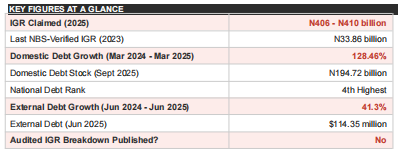

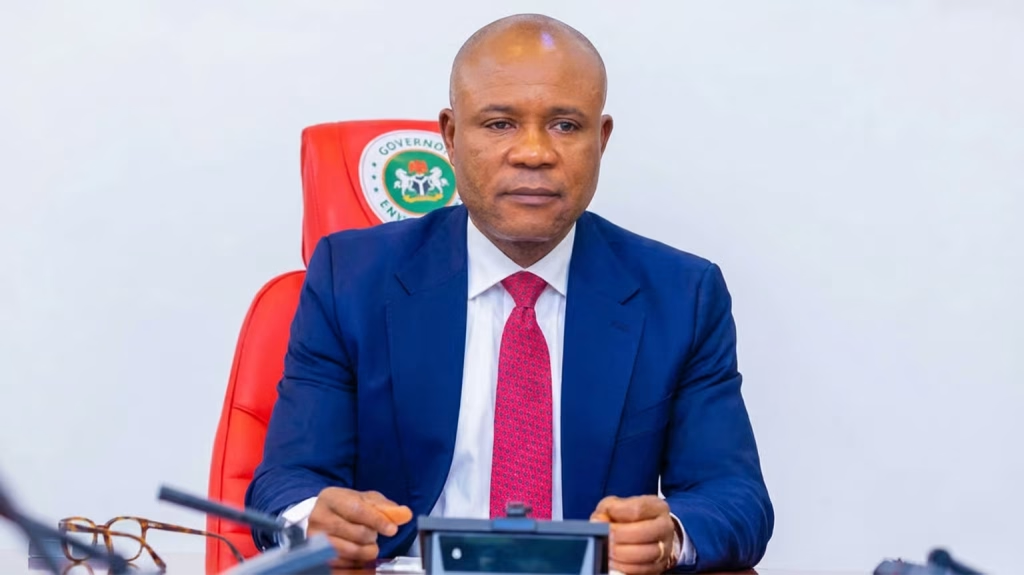
Enugu State says it generated N410 billion in revenue last year. The government called it
historic. Officials celebrated.
The figure circulated on social media, in press briefings, and across party channels as evidence of transformation. But during the same period, the state’s debt surged by 128 percent.
Those two facts cannot coexist without explanation. And so far, there has been none. For nine consecutive years, 2015 through 2023, the National Bureau of Statistics recorded Enugu’s Internally Generated Revenue between N14 billion and N33 billion annually.
The state’s average growth rate was 8.2 percent per year. Modest. Steady. Believable. Then, according to state claims, the following happened:
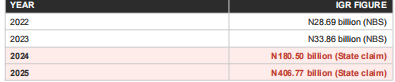
From N33.86 billion to N406.77 billion in two years is a 1,101 percent increase. No state in
Nigeria has ever reported a comparable leap.
The NBS has not independently verified either the 2024 or 2025 figures. No audited breakdown has been published.
Extraordinary claims require extraordinary evidence. The evidence has not arrived.
The Debt Management Office of Nigeria tells a different story about Enugu’s finances. Between March 2024 and March 2025, Enugu’s domestic debt grew from N82.48 billion to N188.42 billion, a 128.46 per cent increase over 12 months.
By September 2025, the Debt Management Office (DMO) placed Enugu’s total domestic debt at N194.72 billion, making it the fourth most indebted state in the entire federation.
Only Lagos, Rivers and Delta carry more domestic debt. Every other state in the Southeast
reduced its debt in the same period.
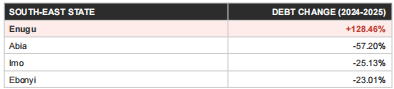
Three of Enugu’s four South-East neighbours cut their debt. Enugu went the other way —
aggressively.
Enugu is also accumulating dollar-denominated debt at a pace that has gone largely unreported. External debt rose from $80.91 million in June 2024 to $114.35 million by June 2025 a 41 percent increase in one year.
As the naira weakens, every dollar borrowed becomes more expensive to repay in local currency. That cost is borne by Enugu’s taxpayers.
THE QUESTIONS THAT DEMAND ANSWERS
Good governance is not measured by what a state collects. It is measured by what it does with what it collects. And on that measure, Enugu’s numbers raise three questions the government must answer:
- If N410 billion was genuinely collected, why is debt rising at 128 percent instead of falling?
- Is the N410 billion gross revenue before agency fees and deductions or actual net cash available to the state treasury?
- Which specific capital projects justify borrowing this aggressively while simultaneously announcing a revenue breakthrough?
A state cannot be high-revenue, high-debt and liquidity-strained all at once without explanation.
The Enugu State Government should reconcile those figures against CBN and TSA records. Show how the escalating debt was deployed. It should publish a repayment schedule.
The state heads into an election cycle carrying a fiscal story that is, at best, unverified and,
at worst, a ticking time bomb to the welfare of the citizens. Voters deserve to know which it
is before they are asked to renew their mandate to this government.
If the revenue is real, prove it. If the borrowing is strategic, show the returns. If the development is transformative, name the outcomes, as the state citizens are alien to these
benefits but the bearers of its burden.
Because in 2027, the question on every ballot will not be about speeches. It will be about
credibility
Numbers do not campaign. They reveal.