


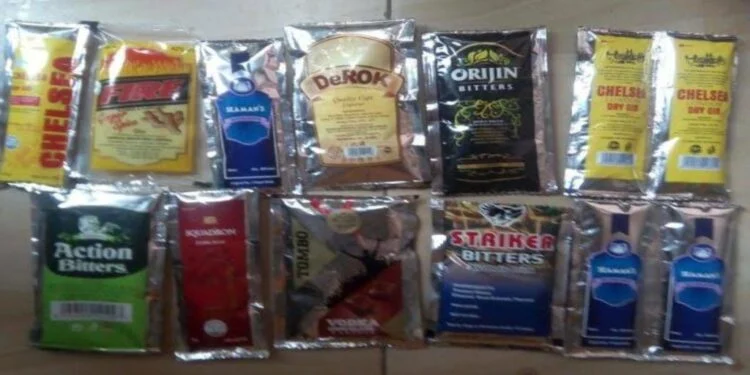
The National Agency for Food and Drug Administration and Control (NAFDAC) has resumed enforcement of the ban on the production and sale of alcoholic beverages in sachets and small bottles below 200 millilitres, the agency said, while dismissing claims that any alcohol‑producing company has been shut down in the process.
The clarification came in a statement from the agency on January 29, 2026.
NAFDAC said the enforcement of the ban follows a resolution by the Nigerian Senate and aligns with its statutory public health mandate, supported by the Federal Ministry of Health and Social Welfare.
The agency emphasised that its action is aimed at safeguarding vulnerable groups, particularly children, adolescents and young adults, from the harmful effects of easy access to inexpensive alcohol.
Director‑General Prof. Mojisola Christianah Adeyeye clarified that enforcement is limited to two packaging formats: spirit drinks sold in sachets and alcoholic beverages in PET or glass bottles below 200ml.
“This ban is not punitive; it is protective,” she said in the statement, underscoring that the measure is designed to make alcohol less accessible to minors and curb misuse across communities.
Adeyeye rejected assertions that enforcement has led to the closure of any alcohol manufacturing company, stressing that the regulation targets packaging types rather than companies.
She noted that larger pack sizes remain approved for production and sale, and only the banned categories are subject to enforcement.
The agency recalled that a Memorandum of Understanding signed in December 2018 with industry stakeholders had established a phased approach to eliminating sachet and small‑pack alcohol by an initial deadline of January 31, 2024, later extended to December 2025 to allow manufacturers to exhaust existing stock and reorganise production lines.
The current enforcement phase is consistent with that agreement and Nigeria’s commitments under the World Health Assembly Global Strategy to Reduce the Harmful Use of Alcohol.
NAFDAC’s announcement comes amid public debate, including concerns from industry groups and labour associations about potential economic and employment impacts of the ban. Some stakeholders have argued that the enforcement could disrupt businesses and investment in the sector, calling for balanced regulatory approaches that protect both public health and economic interests.
The agency said it will continue working with the Federal Ministry of Health and Social Welfare, the Federal Competition and Consumer Protection Commission, and the National Orientation Agency to enhance nationwide sensitisation on the regulation’s health and social objectives, particularly with respect to preventing underage access to alcohol.
NAFDAC reiterated that the regulation targets only specific packaging formats and urged manufacturers, distributors and retailers to comply fully with the law, emphasising that no further extensions to the phase‑out period beyond December 2025 will be granted.