


The Federal Government (FG) has directed the immediate commencement of palliative repairs — mostly at night — on the Lagos–Ota–Abeokuta Road, a key stretch linking Lagos and Ogun States, following critical structural failures that have hindered the free movement of vehicles, officials said on Tuesday, January 13, 2026.
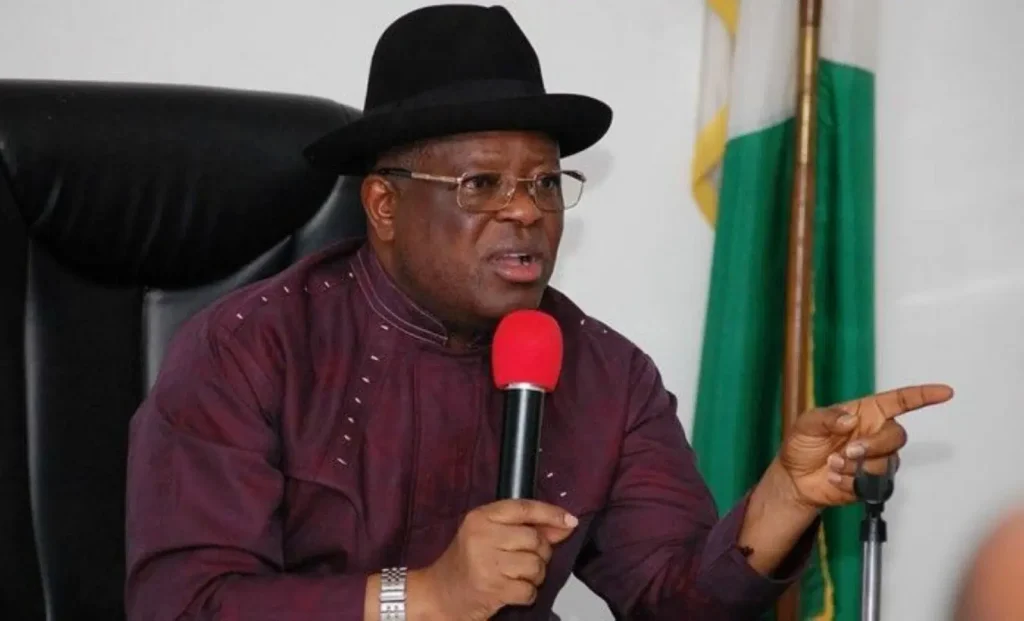
The directive was issued by Senator Dave Umahi, Minister of Works, during an inspection of the federal highway corridor. Umahi said the road, which extends through parts of the Lagos–Ota–Abeokuta corridor, was assessed over approximately 22 kilometres, with priority intervention set for about 18 kilometres of the most distressed sections.
Umahi attributed the road failure to unresolved concession issues and the use of incorrect engineering parameters during earlier construction works, noting that the Ota-bound carriageway has deteriorated more severely than the Lagos-bound side.
He ordered that palliative repairs commence immediately, targeting low-lying failed areas to be reconstructed with concrete for enhanced durability.
The minister said the night-time focus for repairs was chosen to help restore traffic flow on the busy federal highway during daytime hours and minimise disruption to road users. Umahi stressed that the Federal Government was already undertaking work on about 60 kilometres of the corridor in phased interventions, based on urgency and severity of damage.
Umahi also outlined plans for a second phase of the project, which would involve full resurfacing of the highway, replacement of bridge expansion joints, and installation of solar-powered streetlights to improve safety and visibility along the route.
He assured that once the ongoing works are completed, the concessionaire will resume operation and maintenance of the road.
Infrastructure analysts say the road is a strategic artery for commercial traffic between Lagos and Ogun States, and its deterioration has long affected commuters, transporters and local businesses.
The move to prioritise night-time palliative works reflects government efforts to balance urgent repair needs with minimal disruption to the heavy flow of traffic typical of the corridor.
Next steps: Repairs are already underway at night under the supervision of the Ministry of Works, with the second phase of reconstruction and upgrades expected to begin as soon as current palliative operations stabilise the most damaged sections. The Federal Government has urged motorists to exercise caution and adhere to traffic advisories during the repair period.