


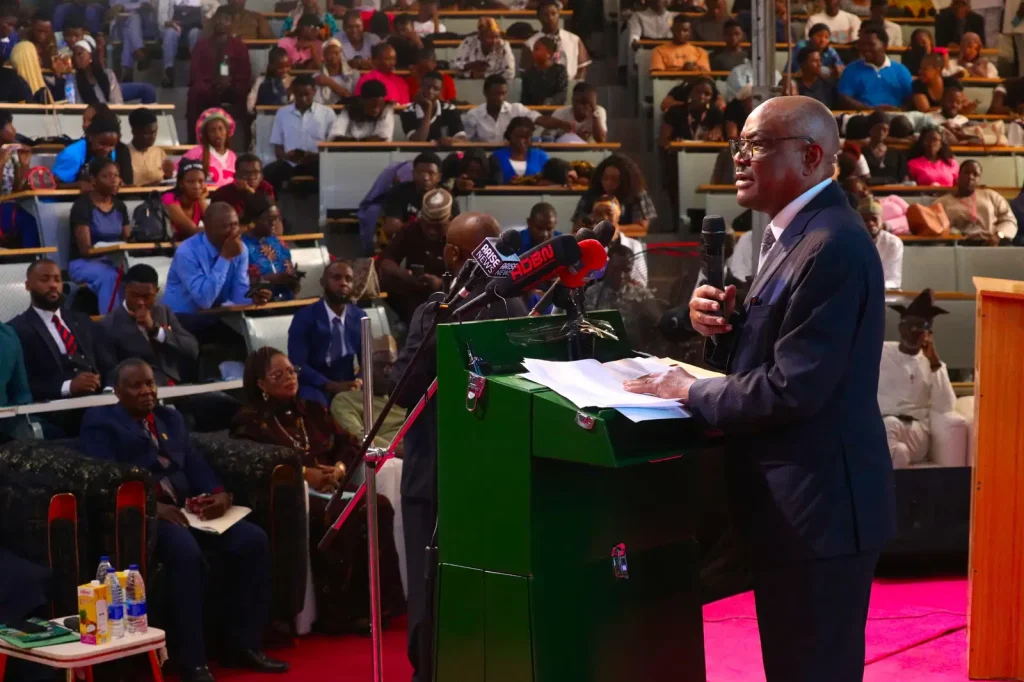
The Minister of the Federal Capital Territory (FCT), Nyesom Wike, has said that democracy must go beyond periodic elections to deliver visible infrastructure, effective public services, and measurable improvements in citizens’ lives.
Wike made the remarks while delivering a Distinguished Personality Lecture at the University of Abuja. The lecture focused on the theme of political leadership and its impact on infrastructural development, drawing attention to the connection between governance, policy execution, and national growth.
Democracy and Tangible Outcomes
According to the minister, democratic governance must be evaluated by its outcomes. He stated that for many citizens, the true meaning of democracy is reflected in functioning roads, accessible healthcare, quality education, security, and economic opportunities.
He described democracy as a social contract that requires accountability, transparency, and responsiveness from leaders.
He told the audience that elections are only one part of the democratic process, adding that the real test lies in whether governance structures translate public resources into public goods.
Wike said that leadership determines how effectively institutions function and how efficiently policies are implemented.
He stressed that political office holders must move from campaign rhetoric to concrete delivery of services that directly impact communities.
Policy and Institutional Reforms
The minister noted that effective democracy requires strong institutions backed by sound policy frameworks.
He said reforms must focus on improving public sector efficiency, strengthening procurement processes, and ensuring that budgetary allocations are aligned with development priorities.
Wike emphasized that policy reforms should address bottlenecks that delay project execution. He said reforms in land administration, revenue collection, and project monitoring are critical to accelerating infrastructure delivery in the FCT.
He also highlighted the need for transparent governance systems that allow citizens to track projects and hold leaders accountable.
According to him, democratic reforms must strengthen institutions rather than individuals, ensuring continuity and sustainability beyond electoral cycles.
Infrastructure as a Foundation for Development
A significant portion of Wike’s lecture centered on infrastructure as the backbone of economic growth. He identified transportation networks, urban renewal, water supply, and public facilities as essential drivers of development.
Wike cited ongoing infrastructure projects within the FCT, including expansion of road networks and development initiatives in satellite towns. He said that extending development beyond the city center is part of a broader effort to ensure inclusive growth.
According to him, infrastructure development is not merely about construction but about improving productivity, attracting investment, and enhancing quality of life.
He stated that roads facilitate commerce, schools build human capital, and hospitals strengthen social stability.
He added that infrastructure projects must be planned within a long-term development strategy to avoid duplication and ensure optimal use of public funds.
Leadership and Governance
Wike told the audience that leadership plays a decisive role in determining whether democratic systems produce meaningful outcomes. He said that leaders must demonstrate discipline, political will, and commitment to public interest.
He referenced democratic governance scholars in explaining that sustained development depends on institutional strength and responsible leadership.
According to him, leaders must be prepared to make difficult decisions and prioritize projects that yield long-term benefits over short-term political gains.
The minister said that effective leadership requires coordination among agencies and consistency in policy direction. He noted that fragmented governance structures can slow down development and reduce the impact of public spending.
Role of Universities and Civic Responsibility
Addressing students and academics, Wike said universities should serve as platforms for civic education and democratic engagement.
He encouraged higher education institutions to nurture informed citizens who understand governance processes and participate constructively in national development.
He stated that universities should promote research that supports evidence-based policymaking and fosters innovation in public administration. According to him, strengthening the link between academia and government can improve policy design and implementation.
Development and Democratic Dividends
In concluding his lecture, Wike reiterated that democracy must deliver measurable dividends. He said that citizens expect visible improvements in their daily lives and that governments must respond with clear development outcomes.
He maintained that infrastructure expansion, policy reforms, and accountable leadership are interconnected pillars of democratic governance. According to him, when leadership aligns with institutional strength and effective policy execution, development becomes sustainable.