


The Federal Government has inaugurated a high-purity gold refining plant in Lagos and announced that a $600 million lithium processing facility in Nasarawa State is ready for commissioning, advancing national efforts to shift from raw mineral exports to in-country processing, the Minister of Solid Minerals Development, Dr. Dele Alake, said on Tuesday, January 13, 2026.
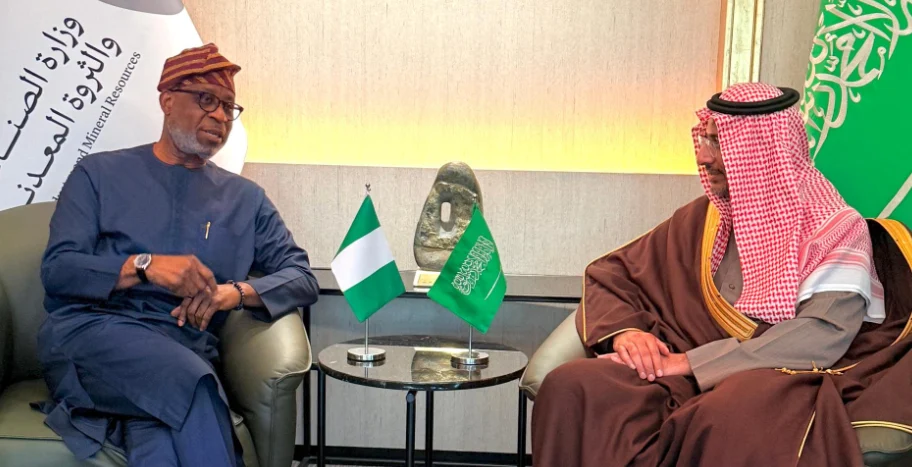
Alake disclosed the developments during a meeting with Saudi Arabian Minister of Industry and Mineral Resources, Mr. Ibrahim Al-Khorayef, held ahead of the Future Minerals Forum (FMF) in Riyadh, Saudi Arabia.
The engagement was aimed at deepening bilateral cooperation in solid minerals development and translating earlier discussions into actionable outcomes.
According to a statement by Segun Tomori, Special Assistant on Media to the minister, the Lagos refinery is already operational, while three additional gold refineries are at various stages of development across the country.
The Nasarawa lithium processing plant, valued at $600 million, is ready for commissioning as part of the government’s strategy to strengthen domestic mineral beneficiation.
Alake said these projects reflect the Federal Government’s value-addition policy, which is designed to reposition Nigeria as a leading minerals hub in Africa and a strategic partner in global supply chains for critical minerals central to the green energy transition.
He noted that the policy aims to reduce the export of unprocessed minerals and promote in-country processing and beneficiation.
“Nigeria’s value-addition policy is already yielding tangible results, with a gold refining plant of very high purity now operational in Lagos, three additional gold refineries at various stages of development, and a $600 million lithium processing plant in Nasarawa State ready for commissioning,” Alake said.
The minister also highlighted the importance of strengthening the Nigeria-Saudi Arabia partnership, especially in areas such as capacity building, training of mining professionals, technology transfer and exploration, with a joint working group between Nigerian officials and the Saudi Chamber of Commerce expected to present a report by the end of the FMF.
In his remarks, Minister Al-Khorayef reaffirmed Saudi Arabia’s longstanding partnership with Nigeria and agreed on the need for practical, actionable agreements to accelerate mineral sector development.
He encouraged Nigeria to use the FMF platform to showcase investment opportunities in its mining sector to Saudi and other international investors, particularly for critical minerals.
Nigeria’s broad landmass and rich endowment of critical minerals and rare earth elements have positioned the country to attract investment and contribute to global demand for battery and clean-energy inputs.
The government has intensified reforms aimed at curbing illegal mining, attracting investment and enhancing local processing capacity as part of national economic diversification strategies.
Next steps: Officials said focus will now shift to finalising commissioning of the Nasarawa lithium plant, expanding gold beneficiation capacity across the country, and leveraging partnerships to ensure sustainable mining sector growth and integration into global value chains.