

With barely 13 months to the 2027 general elections, a wave of high-profile defections into the ruling All Progressives Congress (APC) has transformed political dynamics in several states, but also exposed internal tensions and uncertainty over nomination tickets and leadership roles, a report by Vanguard News shows.
The movement of five sitting governors from the Peoples Democratic Party (PDP) into the APC — spanning Akwa Ibom, Delta, Bayelsa, Rivers, Plateau and Enugu — has strengthened the ruling party’s numerical advantage.
However, it has also heightened concerns that unresolved rivalries and competitive ambitions may undermine internal cohesion ahead of the election cycle.
In Akwa Ibom State, the defection of Governor Umo Eno in June 2025 has triggered a brewing contest over APC ticket allocations, particularly between state power broker Senate President Godswill Akpabio and lawmakers and officeholders who crossed with Eno.
Party insiders warn that “sharing tickets will displace many of us who followed Eno into APC”, with some defected members exploring alternative platforms ahead of primary elections.
Delta State’s political terrain has also shifted following Governor Sheriff Oborevwori’s April 2025 defection alongside predecessor Senator Ifeanyi Okowa.
While both leaders have consolidated control within the APC and secured endorsements as leading candidates, internal fault lines loom in Delta North Senatorial District, where strained relations between former allies could influence candidate emergence.
In Bayelsa State, Governor Douye Diri’s switch to the APC has given the ruling party control across executive and legislative arms.
Nonetheless, long-standing party factions and shifting allegiances present challenges for unity and ticket distribution, particularly between supporters of key figures such as Senator Heineken Lokpobiri and former governor Timipre Sylva.
The defection of Governor Siminalayi Fubara in Rivers State has rekindled political tensions after a protracted feud with Federal Capital Territory Minister Nyesom Wike, raising questions about intra-party leadership and control of political machinery.
Close to the same period, lawmakers loyal to Wike also moved into the APC, compounding factional competitiveness within the state’s APC ranks.
In Plateau State, Governor Caleb Mutfwang’s anticipated defection — still being finalised as of late 2025 — has unsettled established party structures, with analysts observing that the APC may grapple with internal rivalries between long-standing members and newly integrated figures from the PDP.
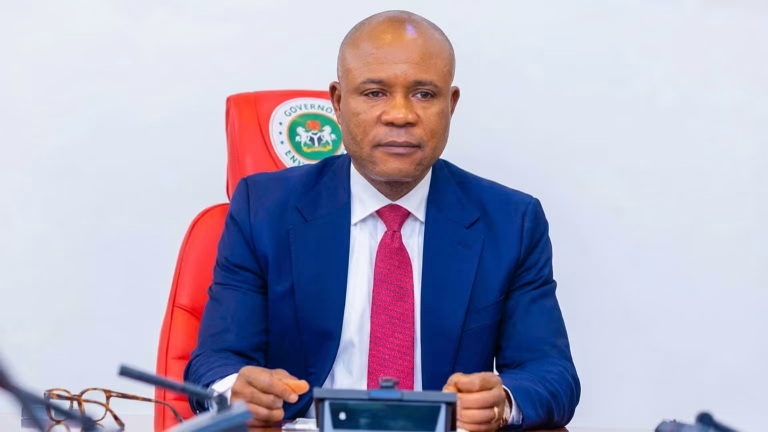
By contrast, the APC chapter in Enugu State shows signs of relative stability after Governor Peter Mbah’s defection, with strategic realignment and leadership consolidation under Dr. Ben Nwoye, the caretaker chairman. Party insiders suggest this state may avoid the level of implosion seen elsewhere.
Political analysts note that these developments will test the APC’s ability to convert elite consensus into grassroots cohesion, striking a balance between accommodating defectors and sustaining long-term internal harmony as the 2027 general elections approach.
As party primaries and candidate selections draw nearer, the APC’s handling of internal ticket distribution and factional interests will be pivotal in shaping electoral prospects and voter confidence across key states.