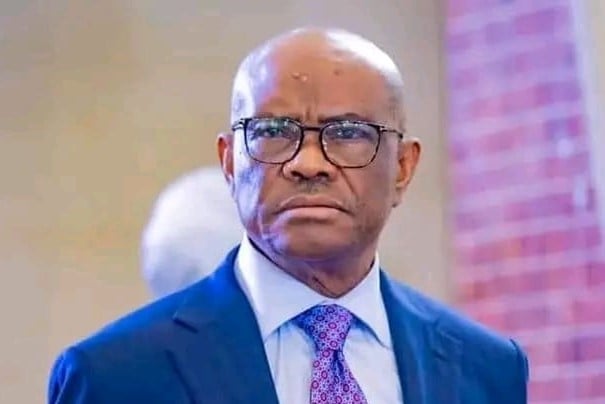
The Minister of the Federal Capital Territory, Nyesom Wike, has criticised former Vice President Atiku Abubakar over his changing position on fuel subsidy.
Wike described the African Democratic Congress presidential candidate as a “voodoo economist” and questioned his credibility ahead of the 2027 presidential election. The minister spoke while responding to journalists during an inspection of ongoing road projects in Abuja.
Atiku recently said he would restore fuel subsidy if elected president, arguing that the funds saved from its removal had not been properly used to reduce poverty and improve education. He also said anyone who allegedly misappropriated the funds should be made to refund them. Wike, however, pointed to Atiku’s earlier position in 2022, when the former vice president said he would remove the subsidy within his first 100 days in office. The FCT minister said the apparent reversal demonstrated inconsistency.
“Atiku would say anything just to be president,” Wike said, questioning whether the former vice president was now returning to a subsidy arrangement he had previously described as fraudulent.
He further argued that developments in Nigeria’s petroleum industry could make Atiku’s proposal difficult to implement. According to Wike, the commercialisation of the Nigerian National Petroleum Company Limited means the company is no longer the country’s sole fuel importer or producer. He consequently questioned how a future government would implement subsidy payments for fuel produced by private refiners such as the Dangote Refinery.
Beyond the Wike Atiku subsidy controversy, the FCT minister also dismissed the suggestion that Atiku is among the leading contenders for the 2027 presidency. Wike declared that President Bola Tinubu remains the only leading candidate.
“I disagree with you that Atiku is one of the leading candidates,” he said. “You have only one leading candidate, and that’s Asiwaju Ahmed Bola Tinubu.”
Wike further predicted that the 2027 election would be easier for the ruling party than the 2023 contest. He attributed this to what he described as the absence of a sufficiently coordinated opposition movement capable of challenging the government. According to him, opposition parties have not demonstrated the unity required to present a formidable challenge to the ruling party.
“I see that there was more opposition in 2023 than now,” he said, arguing that the 2027 election was effectively already decided because there was no united opposition seeking to wrest power.
Wike also defended the Tinubu administration’s decision to remove fuel subsidy. He argued that the policy had increased revenues available to the federal, state and local governments and eased pressures around salary and pension payments. According to him, the increased allocations have changed the financial circumstances of many governments.
“Nobody talks about non-payment of pensions, nobody talks about non-payment of salaries,” he said.
Wike maintained that rather than promising to restore subsidy, political leaders should focus on ensuring that the savings generated from its removal are properly utilised.
The minister also expressed satisfaction with the progress of ongoing road projects inspected in the Federal Capital Territory. His assessment came amid broader discussions about infrastructure development and governance in Abuja. On concerns over insecurity, Wike rejected claims that armed robbery had increased significantly in the capital. He acknowledged that isolated incidents could occur but said available security reports had not indicated a general increase in armed robbery.
“I am not saying there are no one or two incidents of crime,” he said, adding that security agencies would notify the administration whenever serious incidents occurred.
The minister also responded to complaints that some Area Council chairmen were not matching the pace of infrastructure development recorded under the FCT administration. Wike said residents should hold the elected council officials accountable for their performance. He stressed that the chairmen were elected by residents and were therefore constitutionally answerable to them.
“They are the people who elected them. They should ask them,” Wike said.
He added that he did not appoint the council chairmen and therefore could not assume responsibility for their performance. The latest exchange places Wike Atiku subsidy differences within the wider political contest ahead of 2027, as debates over economic policies, opposition strategy and Tinubu’s re-election prospects increasingly dominate Nigeria’s political discourse.