



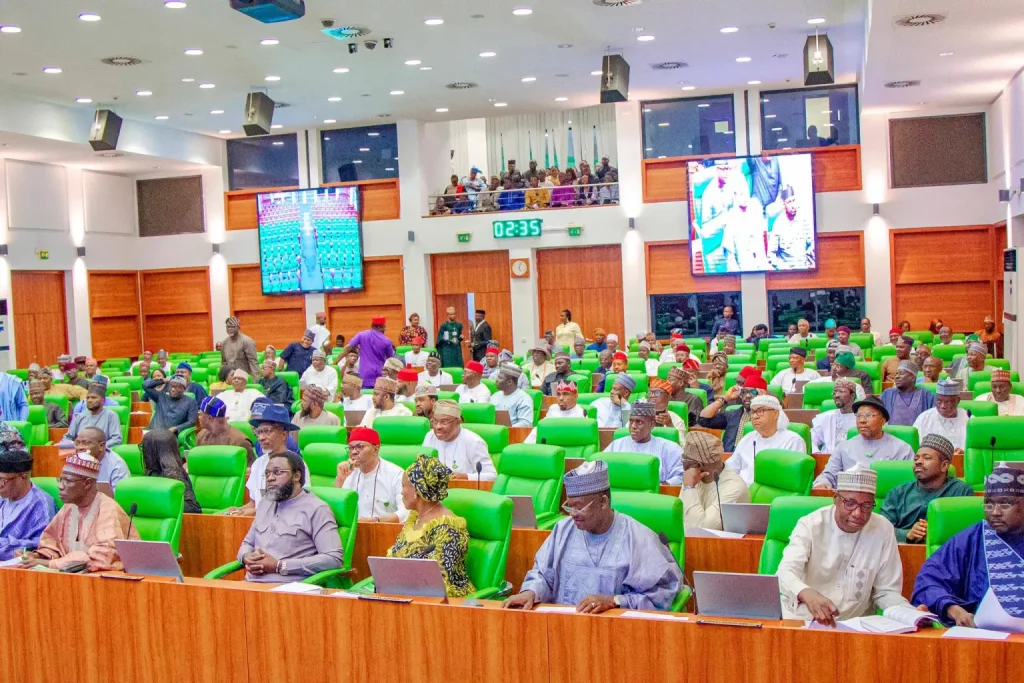
The State Police Bill has cleared a major legislative hurdle after the House of Representatives approved a constitutional amendment seeking to establish state police services across Nigeria, despite a dramatic protest and walkout by members of the minority caucus.
The proposed legislation, formally titled “A Bill for an Act to alter the Constitution of the Federal Republic of Nigeria, 1999 to provide for the establishment of state police services and for related matters,” secured the constitutionally required two-thirds majority during Thursday’s plenary. The bill forms part of President Bola Tinubu’s broader security reform agenda aimed at decentralising policing and strengthening Nigeria’s response to growing security challenges.
If harmonised with the Senate version, approved by at least 24 state Houses of Assembly, and signed into law by the President, the State Police Bill will create the constitutional foundation for state-controlled police services.
Presenting the report of the House Committee on Constitution Review, Deputy Speaker Benjamin Kalu described the proposal as one of the most significant constitutional reforms in Nigeria’s security sector. He praised President Tinubu for transmitting the executive bill, describing it as evidence of productive collaboration between the executive and legislative arms of government.
According to Kalu, the reform is designed to improve intelligence gathering, strengthen community policing and enable state governments to respond more effectively to evolving security threats. He explained that the constitutional amendment merely establishes the legal framework for state police, while issues such as recruitment, funding, operational standards, accountability and coordination would be addressed through subsequent legislation.
Proceedings became heated during the Committee of the Whole after Speaker Tajudeen Abbas put the bill to a voice vote rather than conducting a clause-by-clause consideration traditionally associated with constitutional amendment bills.
Before the vote, Abbas announced that 311 lawmakers had indicated support for the legislation. According to him, the figure comprised 211 members of the All Progressives Congress (APC), 65 lawmakers from other political parties physically present, and 35 members participating virtually.
He noted that the Constitution requires at least 240 votes, representing two-thirds of the 360-member House, for a constitutional amendment to succeed. Following the voice vote, the Speaker declared that the “ayes” had prevailed.
The decision immediately triggered protests from members of the minority caucus, who staged a walkout from the Green Chamber. Minority lawmakers argued that the House failed to follow constitutional and parliamentary procedures by not reading and voting separately on each of the bill’s 26 clauses.
Minority Leader Frederick Agbedi repeatedly attempted to raise a point of order but was not recognised by the Speaker before the vote proceeded. The protest briefly created a rowdy atmosphere inside the chamber, with the Speaker repeatedly using the gavel in an effort to restore order.
Speaking after the walkout, minority caucus spokesman Afam Ogene insisted that the opposition was not against the establishment of state police. Instead, he argued that lawmakers were protesting what they described as procedural violations.
Ogene questioned how the number of lawmakers present was determined, maintaining that attendance should be based solely on the official register signed before plenary. He also argued that constitutional amendment bills require each clause to be individually debated, amended where necessary and approved by a two-thirds majority.
Agbedi similarly maintained that while the caucus supports any initiative capable of improving Nigeria’s security, Parliament must strictly comply with constitutional requirements. He questioned whether a constitutional amendment could legitimately be passed through a voice vote.
In a letter dated July 22, 2026, addressed to the Speaker and signed by Ogene, the minority caucus reiterated its support for the State Police Bill but requested that it be recommitted for further legislative work.
The lawmakers argued that the current draft contains constitutional ambiguities, governance gaps, drafting inconsistencies and unresolved institutional issues that require additional scrutiny. According to the caucus, constitutional amendments establish permanent institutions and therefore demand the highest level of legislative review.
The minority also raised concerns about the financial implications of establishing state police. The lawmakers warned that transferring policing responsibilities to state governments without providing additional financial resources would create an unfunded constitutional obligation.
To address the challenge, they proposed transferring 15 per cent of the Federation Account allocation currently accruing to the Federal Government to states to support policing responsibilities. They also recommended that constitutional lawyers, security experts, fiscal authorities, state governments and other stakeholders participate in a limited technical review before final adoption of the legislation.
The House’s approval represents a significant milestone in Nigeria’s long-running debate over decentralised policing. However, the State Police Bill must still be harmonised with the Senate version, approved by at least 24 state Houses of Assembly, and receive presidential assent before becoming part of the 1999 Constitution.
If successfully enacted, the legislation is expected to reshape Nigeria’s policing structure by creating a constitutionally recognised multi-level law enforcement system aimed at improving security nationwide.