

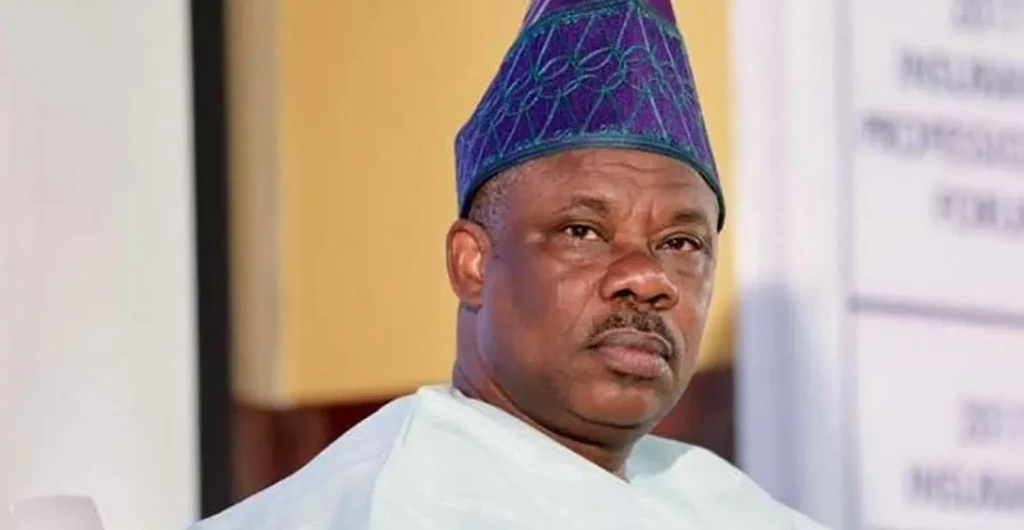
Senator Ibikunle Amosun, former governor of Ogun State, has called on Nigeria’s geopolitical zones particularly in the North, to respect the country’s presidential rotational arrangement by allowing President Bola Ahmed Tinubu to complete a full tenure and be supported for a second term in the 2027 general election.
Amosun made the appeal on Sunday, January 25, 2026, while addressing All Progressives Congress (APC) leaders, party members and well-wishers during activities marking his 68th birthday at the Ake Palace Pavilion in Abeokuta.
Amosun emphasised that the principle of power rotation, an informal political understanding aimed at balancing leadership between Nigeria’s North and South should be observed to foster national unity, fairness and stability.
He noted that after an eight-year presidency under the late President Muhammadu Buhari from the North, it is “only fair and just” for the South to complete an eight-year period under Tinubu, who hails from the South-West.
Power rotation has emerged as a recurring theme in Nigeria’s democratic discourse, particularly ahead of major elections. Proponents argue that alternating the presidency between the North and South promotes equity and inclusion among Nigeria’s diverse regions and ethnicities.
Opponents, however, caution that such arrangements risk overshadowing merit-based political competition or formal constitutional frameworks
At the event, Amosun reaffirmed his loyalty to the APC and openly declared support for Tinubu’s re-election bid, framing it as consistent with the rotation principle and beneficial to national peace.
“President Tinubu is representing all of us in the South … and it is a no-brainer for anybody who loves Nigeria to agree that whatever we are doing, we should respect that rotational arrangement,” he said.
While acknowledging that some policies of the Tinubu administration have brought hardship to Nigerians, Amosun asserted that ongoing reforms were beginning to deliver positive results, encouraging continued support for the president’s agenda.
Amosun’s remarks reflect broader political momentum within segments of the APC and allied groups advocating for Tinubu’s continuation in office.
Related developments include endorsements from former legislators who have backed Tinubu and called for the rotational presidency principle to guide political planning, including proposals for constitutional entrenchment of rotational arrangements to enhance clarity and national cohesion.
Critics of strict rotational expectations argue that legal and democratic processes should remain paramount and that constitutional mechanisms such as electoral laws, provide sufficient safeguards for inclusive governance.
Some commentators have urged political actors to focus on legal reforms rather than informal arrangements as Nigeria prepares for the 2027 polls.
Amosun’s call adds to discussions shaping the political landscape ahead of the 2027 general election, underscoring how debates over power rotation may influence party strategies, voter perceptions and inter-regional relationships within Nigeria’s multiparty democracy.
As parties build their platforms and coalitions, the interplay between regional balance and democratic competition is expected to remain a central theme.
As the 2027 electoral cycle unfolds, political stakeholders and citizens alike will continue to engage with the question of how best to balance national unity, regional equity and democratic principles.
Amosun’s appeal for respect of rotational arrangements and his support for Tinubu’s continuation point to ongoing efforts by some leaders to align political choices with broader narratives of fairness and stability in Nigeria’s governance architecture.